Showing posts with label Historical Fiction. Show all posts

Monday, October 5, 2026

Supernatural Review: Soldier's Joy by M.F. Jones

War may end on the battlefield, but its consequences rarely obey a cease-fire. In Soldier’s Joy, M. F. Jones brings that reality home with Avery Gowan, an Iraq veteran carrying the guilt of a mission that killed three of his friends and maimed another. His return becomes even more complicated when he encounters a ghost who looks disturbingly like him—and who insists that a woman Avery has only recently met may be the person who can help him.

That woman is Jessie Gibbs, whose connection to Avery’s Civil War ancestor, Lemuel Sanders, began with the discovery of his unmarked grave and extends into territory Avery cannot yet understand. As Book II of The Sentinel Heart Trilogy, Soldier’s Joy links the wounds of two wars through family history, a supernatural guardian, and a relationship in which both Avery and Jessie are keeping consequential secrets.


Romance: Historical, Supernatural, Military

Release Date: Sep 28, 2026

Publisher: Fieldwood Books

Category: Adult Fiction (18 yrs +)

Series: Book II of The Sentinel Heart Trilogy

Content Rating: PG-13 + M: Soldier's Joy contains wartime violence, the suicide of a minor character, two slightly explicit sex scenes though without gratuitous detail, and profanities like s**t, a**hole, and God damn it, though no f-words.


༺ ABOUT THE BOOK ༻


Avery Gowan is barely home from Iraq when a ghost appears to him—one that looks disturbingly like him. The apparition says that Jessie Gibbs, a woman he’s just met, can help him escape the guilt of the mission that killed three of his friends and maimed another.


A few days earlier, at a service honoring his family’s Civil War relative, Lemuel Sanders, Avery was drawn to Jessie’s quiet strength and calm presence. Jessie, a musician, had been camping with her Civil War-style band the previous year when she discovered Lemuel’s unmarked woodland grave, leading to his identification and proper burial after 145 years.


Jessie and Avery begin a relationship, but his anger, recklessness, and self-doubt threaten to tear them apart. When the ghost saves him from a deadly motorcycle crash, Avery hides the truth about his spectral guardian, afraid Jessie will see him as broken beyond repair.


But Jessie is hiding something too—a secret about her true connection to Lemuel Sanders that may cost her Avery’s love.


The sequel to the award-winning Stones River, Soldier’s Joy nonetheless stands alone as a haunting, emotionally charged story about how the past refuses to stay buried, how healing demands facing it, and how love gives the courage to do so.


༺ My Review ༻

The Author Gives Us Another Unique Story. I enjoyed Stones River, the first book in The Sentinel Heart Trilogy, so I was looking forward to seeing where M. F. Jones would take us in the next book. As much as I liked the first book, I think I liked Soldier's Joy just a little more. This time, Jones brings Civil War history together with the story of a soldier returning home from Iraq, along with romance, family secrets, and the supernatural thread connecting the past and present. I really liked how those pieces were woven together, especially as the connection between Avery and Lemuel began to unfold. The book has plenty of military and historical detail, but it never felt like I was being handed a history lesson. It all fits naturally into the story, and the writing flows easily, which made it very readable for me.

Expect to Connect to the Characters. Avery was probably my favorite part of the book. He comes home from Iraq carrying an enormous amount of guilt, and he is definitely not a perfect character. He can be angry, reckless, stubborn, and frustrating, but those flaws made sense considering everything he was trying to deal with. What I really liked was his desire to be a better man, even when he didn't always know how to get there. Jessie balances him well, but she also has her own history and a pretty big secret involving Lemuel, so she never feels like she is simply there to fix Avery. I enjoyed watching their relationship develop, but I also liked getting to know them individually. I had read Stone's River before this one, and while I didn't remember all the details from that first book, I never felt lost here, and immediately reconnected with Jones' characters and settled right into the supernatural elements this time around.

Would I recommend Soldier's Joy? Definitely. In fact, if you enjoyed Stones River, I think you'll like this one even more—I did. It has historical fiction, romance, military fiction, mystery, and a touch of the paranormal, but underneath it all is a very human story about guilt, grief, healing, and figuring out how to move forward when you can't change what happened in the past. I especially liked that the supernatural side never overshadowed the characters or what Avery was going through. 


༺ ABOUT THE AUTHOR ༻


M. F. JONES is a former editor for Viking Press book publishers, and Redbook, Family Circle, and Reader’s Digest magazines. When not writing, she can be found reading, knitting (while listening to audiobooks), singing in a choir, or hiking in the beautiful Tennessee woods near the home she shares with her husband, composer Douglas Hedwig.

༺ CONNECT WITH THE AUTHOR ༻


Website

Facebook

Goodreads


༺ BUY THE BOOK ༻


Amazon

Barnes & Noble

Books-A-Million

Bookshop.org


༺ LAST WORD ༻

Soldier’s Joy places its most important conflict in the space between what has happened and what its characters are willing to face. Avery cannot change the Iraq mission that cost his friends so dearly, and Lemuel’s death belongs to a war fought generations earlier, yet neither history is finished exerting its influence. Jessie’s place between those stories makes the novel’s secrets particularly consequential: the person Avery has been told can help him is also keeping information capable of changing what he believes about her.


That convergence of military history, supernatural intervention, and concealed family connections gives this second Sentinel Heart novel its own identity. Avery may have come home from Iraq, but Soldier’s Joy is concerned with the much harder question of what coming home requires after the fighting is over—and what can happen when the past arrives there waiting for you.




༺ JOIN THE CONVERSATION ༻

 
Be the first to see cover reveals, upcoming releases, exclusive excerpts, author features, and more. Join our growing community of readers and book lovers.

 ➡️ Join our Newsletter


Tuesday, September 29, 2026

Women's Fiction Teaser: It's All About Love by Cynthia Hilston

Juliette wants the freedom promised by 1967 San Francisco, but the first pages of her rebellion reveal how differently freedom can look from either side of a family divide. In It’s All About Love, Cynthia Hilston places a twenty-year-old determined to choose her own future against parents whose objections are rooted in experiences their daughter does not fully understand. Her engagement to David becomes more than an argument over a boyfriend when she leaves home for Haight-Ashbury, forcing Juliette, Lorna, and Tristan to confront the difference between protecting someone you love and allowing that person to make choices of her own.


Women's Fiction / Historical Fiction / Romance

Date Published: 11-10-2026


༺ ABOUT THE BOOK ༻

 
San Francisco, 1967. The Summer of Love promises radical freedom—but for twenty-year-old Juliette, it becomes a dangerous trap.
 
 
Desperate to escape her conventional family, Juliette shocks her parents by announcing her engagement to David, a long-haired free spirit. When her father, Tristan—a famous novelist harboring a tragic past—vehemently forbids the union, Juliette acts on impulse. In the dead of night, she climbs out her window and flees with David to the counterculture epicenter of Haight-Ashbury.
 
 
But beneath the cloud of incense and rock 'n' roll, independence carries a steep price. As David drifts into a haze of drugs and broken promises, Juliette’s bohemian dream shatters. Back home, her flight reopens old wounds. Her fiercely protective mother, Lorna, must help Tristan confront the shadows of his past as they desperately try to pull their daughter back from the edge before it's too late.
 
 
It’s All About Love is a poignant coming-of-age story about the fragile line between rebellion and destruction and the enduring, messy grace of family.


༺ WHY READ THIS BOOK ༻


The conflict in It’s All About Love works on two timelines at once: Juliette is trying to claim a future for herself while Tristan’s response is shaped by a past he cannot simply leave behind. That gives the family’s disagreement more weight than a straightforward generational clash. The 1967 Summer of Love and Haight-Ashbury provide a setting built around promises of personal freedom, while Juliette’s experience asks what can happen when independence, impulse, and trust collide. Lorna’s position between a daughter demanding autonomy and a husband recognizing echoes of his own mistakes adds another perspective to a story in which love does not always produce agreement about what is best for someone.


༺ read an excerpt ༻


“I’m getting married!” Juliette burst through the door, holding her ring finger up for the world to see. Well, for my dear husband of twenty-two years and me to see.
            Said dear husband rose from his chair with such gusto that the poor chair clattered to the floor, victim of his temper. “What?!”
            The humid June air clung to the back of my neck as I stood. Pushing my graying hair out of my eyes, I took a step toward my husband and placed a hand on his upper arm. I recognized the fear that flashed beneath his anger. I’d seen that look far too many times lately as she missed her curfew night after night all summer long.  “Tristan, dear, just...calm down, okay?” I cast a pleading glance between him and our daughter. I could see the words on the edge of his tongue. Don’t follow in my footsteps. His own impulsive marriage led to a tragedy that impacted both our lives. I knew the thought of Juliette repeating his mistakes kept him awake at night.
            “Calm down?” Tristan tossed his hands up; then his arms flopped to his thin torso’s sides.
            “Your heart,” I said, stepping in front of him. “Please.”
            He released a sound somewhere between a growl and a groan, then righted his chair and sat. “So, who’s the lucky guy?” he shot at Juliette. “Don’t tell me it’s that long-haired hippie.”
It wasn’t just the hair. David's casual attitude toward drugs reminded Tristan too much of his own dance with addiction, though he'd never admit that to her.
            Juliette stood just inside the open door. Only the screen separated her from darting outside and the darkness swallowing her for another late night. Another night without a curfew. Another night we hoped we could trust her judgment. Another night our little girl proved she wasn’t so little anymore.
            She crossed her arms over her chest and sent her dad a glare worthy of one of his own. Her blue eyes held the same spark that challenged, much like Tristan’s eyes. “Seriously, Dad? Like you should talk.” She gestured toward his messy, longish hair.
            “That’s not the point,” Tristan said, teeth clenched. “You can’t just go running off with the first guy who puts a ring on your finger. If he had any decency, he’d have asked us first.”
            Juliette closed the door and scoffed. “It’s 1967, Daddio.” She popped her gum as she leaned against the table. “I don’t need your permission.”
            “Like hell you don’t.” Tristan stood, the menacing tone creeping back into his voice.
            I came between them. “Okay, both of you… Can’t we talk about this?”
            Juliette shifted her gaze to me. “Mom, please. Can’t you make Dad see reason?”
            I held back a sigh and lifted my hand. About to place it on her shoulder, I resisted and let my arm drop. “Juliette, this isn’t a good idea. David isn’t—”
            “Isn’t what, Mom?” A tremor ran through her voice. She blinked rapidly, then stepped away. She headed for the door to the dining and living rooms, stopping before she exited. “Why can’t you just be happy for me for once?” Her footsteps banged through the house and up the stairs. A slam of her bedroom door and I knew it would be unwise to knock anytime the rest of the night. 


༺ WHO WILL LOVE IT ༻


This one should speak to readers who like historical fiction to stay close to the emotional consequences of a changing era. Juliette’s pursuit of the freedom associated with 1967 San Francisco is balanced against Lorna and Tristan’s fear of watching their daughter repeat painful mistakes, making the family relationship as important as the romance. Readers interested in mother-daughter dynamics, complicated marriages, coming-of-age stories, and fiction about the distance between one generation’s experience and the next will find several points of connection here. The Haight-Ashbury setting also gives readers interested in the counterculture years a recognizable historical backdrop for a very personal family crisis.


༺ ABOUT THE AUTHOR ༻


Bestselling and award-winning author of the Lorna & Tristan Series, Cynthia Hilston is a stay-at-home mom of three young kids, happily married, and lives in the Cleveland, Ohio, area. Writing has always been like another child to her. After twenty years of waltzing in the world of fan fiction, she has stepped away to do her debut dance with original works of fiction, although she still dabbles in fan fiction.
In her spare time–what spare time?–she devours books, pets her kitties, looks at the stars, drinks wine or coffee with good friends, and dreams of what other stories she wishes to tell.
 

༺ CONNECT WITH THE AUTHOR ༻

Website

Facebook

Goodreads

Instagram

TikTok: @cynthiahilston

YouTube: @cyndihilston

Newsletter


༺ BUY THE BOOK ༻

Amazon

 Buy the Lorna & Tristan series!


༺ LAST WORD ༻


The opening confrontation makes the emotional problem in It’s All About Love clear without making it simple. Juliette sees an engagement and a new life; Tristan sees the possibility of history repeating itself; and Lorna understands enough of both perspectives to know that neither anger nor reassurance will easily close the distance between them. Moving Juliette from that family argument into the promises and dangers of Haight-Ashbury gives her rebellion consequences beyond shocking her parents. At the same time, the wounds her departure exposes at home suggest that this is not solely Juliette’s coming-of-age story. The family she leaves behind has its own unfinished history to confront.


RABT Book Tours & PR


༺ JOIN THE CONVERSATION ༻


Be the first to see cover reveals, upcoming releases, exclusive excerpts, author features, and more. Join our growing community of readers and book lovers.

 ➡️ Join our Newsletter


Wednesday, September 23, 2026

Historical Fiction Release Blitz: The Lark by Laura C. Rader

Long before Dorothy followed the Yellow Brick Road across movie screens, a young composer was trying to turn L. Frank Baum’s fantastical world into something audiences could experience from a theater seat. Laura C. Rader’s The Lark looks behind the cultural legacy of The Wizard of Oz to Paul Tietjens, whose collaboration with Baum brought Oz to the Broadway stage decades before the 1939 film. Inspired by Tietjens’ 1901 diary, the novel follows an ambitious musician caught between artistic opportunity, family obligation, and a love that could jeopardize the future he is working to create.


Historical Fiction

Date Published: 09-23-2026

Publisher: Echoes Publishing


༺ ABOUT THE BOOK ༻


When The Wizard of Oz graced the silver screen in 1939, it changed cinema and popular culture forever. But the true story began decades earlier with the young composer who risked everything to bring it to the Broadway stage.
 

At the turn of the century, twenty-three-year-old Paul Tietjens is a gifted classical pianist with dreams of greatness and a non-refundable ticket to Europe to study with the master composers of his time.


But when the bank calls in the debt on his family’s Missouri farm, Paul forgoes his dream to save them from financial ruin. Desperate to find a new road to success, he moves to up-and-coming Chicago, where he persuades author L. Frank Baum to collaborate on a comic opera of The Wonderful Wizard of Oz, setting the stage for the defining cultural touchstone that we know today.


Paul embarks on his opera with high hopes, but scandal threatens his soaring ambition when he falls in love with his best friend’s beautiful but married sister, and his fears grow as the Wizard of Oz demands not only his talent but his soul.


Inspired by Paul’s 1901 diary, The Lark follows Paul as he journeys from the theaters of Chicago to the streets of Manhattan, from his family’s Missouri farm to the beaches of Michigan, fighting to hang onto the chance of a lifetime, his integrity, and the woman he loves.


༺ WHY READ THIS BOOK ༻


The Lark turns its attention to a chapter of Oz history that is easily overshadowed by the famous film that followed. Paul Tietjens enters the story not as a distant historical name but as a twenty-three-year-old musician facing an immediate choice between the European education he has planned and the financial crisis threatening his family’s Missouri farm. From there, his collaboration with L. Frank Baum places personal ambition alongside the uncertain work of creating a theatrical production that would become part of the larger Oz legacy.


Rader also has an unusually personal historical source to draw upon: Paul’s 1901 diary. That connection gives the novel a compelling framework for exploring the man alongside the milestone. Chicago theaters, Manhattan streets, family responsibilities, artistic ambition, and Paul’s relationship with a married woman all converge during a period when the future attached to The Wonderful Wizard of Oz was not yet assured. Readers already familiar with Oz can therefore approach its history from a less familiar direction, while the novel’s conflicts remain rooted in the choices of the young composer helping to bring it to the stage.


༺ read an EXCERPT ༻


From Chapter 27 of The Lark by Laura C. Rader


After lunch, I sat at the parlor piano and ran through some of the songs for The Wizard of Oz, replaying each moment with Katherine in my mind as my fingers played the keys. She sat nearby, silently reading Persuasion, our glances meeting now and again as Daisy played with Lina and Vita in between sorting through the boarding house accounts. I mulled over the sanctity of marriage, the frailties of the heart, and the ominous predictions of the palm reader. My fate was surely sealed, and I only prayed I hadn’t somehow thrown Katherine’s completely off course.


༺ WHO WILL LOVE IT ༻


The Lark has a natural place on the reading list of historical-fiction readers who enjoy finding the lesser-known people behind familiar cultural landmarks. Anyone fascinated by The Wizard of Oz will encounter its history before Hollywood made Dorothy, the Scarecrow, the Tin Man, and the Cowardly Lion cinematic icons, with the focus instead on Paul Tietjens and the difficult path toward bringing Baum’s story to the stage.


The novel should also appeal to readers interested in turn-of-the-century Chicago and New York, theater and music history, historical figures reconstructed through surviving personal records, and protagonists forced to weigh ambition against responsibility. Paul’s artistic aspirations are further complicated by his feelings for his best friend’s married sister, adding a personal conflict in which professional success, integrity, family loyalty, and love are all capable of demanding something from him at the same time.


༺ ABOUT THE AUTHOR ༻


In addition to The Lark, Laura C. Rader is the award-winning author of the historical novel Hatfield 1677, based on the lives of her ancestors in Hatfield, Massachusetts, in the seventeenth century.


When she isn’t writing, you can find her researching history for her books and her family tree and spending time with family, friends, and pets.


A native of southern California, she now lives north of Raleigh, North Carolina.


Please go to www.lcrwriter.com for more info on her books or to subscribe to her newsletter.


༺ CONNECT WITH THE AUTHOR ༻


Website

Facebook

Blog

Instagram


༺ BUY THE BOOK ༻


Amazon

Amazon Author Page


༺ enter the GIVEAWAY ༻


༺ LAST WORD ༻


Knowing what The Wizard of Oz eventually became makes Paul Tietjens’ position in The Lark especially interesting. For Paul, there is no legendary film waiting safely in the future and no certainty that his collaboration with L. Frank Baum will become part of an enduring cultural phenomenon. There is only an ambitious young musician trying to seize an opportunity while obligations to his family, his feelings for Katherine, and the demands of the production complicate every step forward.


Rader’s use of Paul’s 1901 diary gives this familiar piece of American cultural history a distinctly personal point of entry. Instead of beginning with Oz as an established icon, The Lark returns to a moment when its theatrical future still depended upon artists making difficult choices behind the scenes. That perspective offers an intriguing reason to look again at a story generations know—and at one of the people who helped carry it toward the stage.


༺ JOIN THE CONVERSATION ༻


Be the first to see cover reveals, upcoming releases, exclusive excerpts, author features, and more. Join our growing community of readers and book lovers.

➡️ Join our Newsletter


Tuesday, September 1, 2026

Speculative Historical Fiction Release Blitz: Uprising by J.E. Rizzo

England in 1381 is already straining under taxation and unrest when Blanche Fitzjohn finds herself caught on both sides of the widening divide. In Uprising, J.E. Rizzo gives that historical conflict an unusual perspective through an illegitimate daughter of John of Gaunt whose heightened hearing and ability to smell emotion make her an outsider even before politics place her in danger. Blanche's loyalty to England's villeins, her connection to the ruling family, an unwanted marriage, and abilities she has regarded as a curse converge as rebellion moves from discontent to open revolt.


Book One of the Fitzjohn Duology


Historical Fiction with Speculative and Romantic Elements

Date Published: 09-01-2026

Publisher: Literary Wanderlust


༺ ABOUT THE BOOK ༻


England, 1381 AD: Blanche Fitzjohn is an outcast in her small coastal village. Not only is she the illegitimate daughter of John of Gaunt, the man responsible for her neighbors’ over-taxation, but she possesses strange abilities: hearing sound from miles away and smelling people’s emotions.
 

She takes solace in her studies with the local wisewoman and in her friendship with Geoff, a groom at the local manor. Until the day Henry of Lancaster, Blanche’s half-brother, brings her news of an arranged marriage to Sir Thomas Prescott, Constable of the Tower of London. Although she smells cruelty on him, Blanche agrees to marry Thomas in the hopes that her influence may help better the lives of Geoff and all England’s villeins. 


But soon, the peasants’ discontent turns to revolt. Though her heart is of the people, Blanche’s nobility makes her an enemy to the rebels. To save herself and Henry from the executioner’s ax, Blanche must use every power at her disposal, even those she once considered a curse.


༺ WHY READ THIS BOOK ༻


Blanche Fitzjohn occupies a particularly difficult place in the conflict at the center of Uprising. She is connected by blood to John of Gaunt and the nobility, yet her sympathies lie with the villeins suffering under the conditions that fuel the revolt. Her decision to accept a marriage to Sir Thomas Prescott in the hope of improving their lives makes that divided allegiance personal long before the rebellion threatens her own survival.


Rizzo adds another layer through Blanche's extraordinary senses. Hearing sounds from miles away and smelling people's emotions could easily function as simple advantages, but Blanche has regarded these abilities as a curse. When political danger forces her to depend upon the very traits that have helped make her an outcast, the speculative element becomes directly tied to her struggle for survival. That combination of medieval unrest, divided loyalties, an arranged marriage, and unusual sensory abilities gives the historical setting a distinctive tension.


༺ WHO WILL LOVE IT ༻


Uprising should appeal to historical fiction readers who like real periods of political upheaval filtered through the life of a character with competing loyalties. Blanche's connection to John of Gaunt places her near power while her friendship with Geoff and concern for England's villeins pull her toward those rebelling against it. Readers interested in medieval England, class conflict, and heroines forced to navigate dangerous social boundaries will find those tensions central to the story.


The novel also offers something different for readers who enjoy historical fiction with speculative and romantic elements. Blanche's heightened senses operate alongside her studies with a local wisewoman, while her arranged marriage to Thomas and friendship with Geoff complicate an already precarious position. Readers who prefer their history blended with an element that pushes just beyond the strictly historical should be especially well matched to this first book of the Fitzjohn Duology.


༺ ABOUT THE AUTHOR ༻


 J.E. Rizzo is a life-long history fanatic and writer of historical fiction, and her work can be found in Vanity Fair, The Boston Globe, The Guardian, The Tudor Times, Tudor Life Magazine, Scary Mommy, and Ultrarunning Magazine. Rizzo won Manuscript Academy’s Agent Choice Award in 2024, and her article Past and Precedence: Abortion Law in the Middle Ages and Its Use to Overturn Roe v. Wade won History Inquiry’s Medieval History Writing Challenge. 


By day, Rizzo works in Human Resources—a field offering more than ample opportunity to observe the follies and fancies of humankind. Before her career in HR, Rizzo worked as an opera singer, a professional baker, and a dog walker. These days, when not writing she can be found running ultramarathons through the forests and mountains of New England, knitting, reading, sewing, baking, or performing any number of (what some might call) old-lady hobbies. She also keeps busing caring for her two children and forty-seven houseplants, making her husband carry heavy things and cook her gourmet meals, and rehabilitating her rescue dog and semi-feral ginger cat.


༺ CONNECT WITH THE AUTHOR ༻


Website

Facebook

Blog

Goodreads

Instagram

BlueSky


༺ BUY THE BOOK ༻


Purchase Today

Amazon


༺ LAST WORD ༻


Blanche's position makes Uprising particularly intriguing: the revolt threatens her because of the noble blood that has already helped make her an outcast among the people whose suffering she understands. Her attempt to use an arranged marriage to improve the lives of others further complicates the usual boundaries between privilege and powerlessness. By the time rebellion places Blanche and Henry in danger of execution, those divided loyalties can no longer remain theoretical.

Her strange abilities sharpen that conflict in an equally personal way. The senses Blanche once considered a curse may become essential when ordinary social protections fail her. Bringing that speculative thread into the upheaval of 1381 gives Rizzo a distinctive way to explore belonging, power, and survival—and leaves Blanche facing a world in which neither her family name nor her sympathies can guarantee which side will claim her as its enemy.


RABT Book Tours & PR


༺ JOIN THE CONVERSATION ༻

Be the first to see cover reveals, upcoming releases, exclusive excerpts, author features, and more. Join our growing community of readers and book lovers.

 ➡️ Join our Newsletter


Wednesday, August 12, 2026

Historical Fiction Book Blitz: Cain's Chameleon by Mark G. Bearss

A newspaper obituary is supposed to close a life, but for Dan Driscoll, seeing his own death in print looks remarkably like an escape hatch. Buried in gambling debt and caught in the aftermath of violence, he has every reason to disappear—and suddenly the world is prepared to believe he already has. In Cain’s Chameleon, Mark G. Bearss follows the consequences of that decision from the shores of Lake Michigan into the upheaval of World War II, where secrets carried from home refuse to remain safely in the past. 


Behind the fiction is an equally intriguing piece of history: Bearss developed the story after finding separate newspaper accounts of an attempted murder near his family’s summer cottage and a drowning victim discovered on the beach where he once played. He wondered whether the two events might have been connected, then turned that unanswered question into a novel.


Historical Fiction

Date Published: 01-27-2026

Publisher: BearssLair Books


༺ ABOUT THE BOOK ༻


If the newspaper reported your death and no one questioned it, would you correct the mistake... or take the lifeline? 
 

Dan Driscoll is consumed by gambling debt, cornered by bookies and loan sharks, forced to bet on one last scheme. When things turn violent and two people are shot, his best friend, Stan Neumann, swallows what he suspects. He can't risk divulging a closely-held family secret. 


Then a body washes up on the Lake Michigan shoreline, and the lake gives Dan what the bookies never would: a way out. Authorities call it an accident and list him as the drowning victim. For Dan, it's an escape route delivered in black ink. 


He becomes a ghost, an imposter, a chameleon. But lies don't stay buried. 


As America is pulled into World War II, Stan enlists, choosing duty on his terms before the draft can rewrite his life. In Pearl Harbor, one chance encounter dredges up a name he thought was long buried. 


War changes everything, but it doesn't erase unfinished business. And when the truth demands to be heard, how long can a stolen life stay buried before the past comes to collect?


༺ read an EXCERPT ༻


Lucy wasn’t smiling like she used to when she folded her letter, slipped it into the envelope, sealed it with a kiss, and applied the three-cent stamp. Even the spring in her step lacked the zeal she typically exhibited during her walk to the post office. The words on the paper were true to her commitment. They spoke of the news from the home front, stories that helped Stan’s morale, and made sure her underlying message was being proud, supportive, and encouraging. The words wandering around in Lucy’s thoughts, however, were in stark contrast to this messaging. 


Ever since Stan was assigned to the navy radar training school, Lucy had become more and more unsure in her belief that things would be okay. His work as an Aviation Machinists Mate stateside meant he was safe. And Minneapolis was relatively close to home. Being trained as a radarman for shipboard duties meant it was more likely he would be sent overseas into a combat zone. This caused a higher level of worry. Like everything else this war has put in short supply, her ration of optimism was slowly being depleted, and the resources for replenishing that reservoir were becoming scarce. 


Her quandary was not letting Stan know about this foreboding, even though he was normally her most trusted sounding board. She tried to talk about this with her sister Millie. But Millie’s approach to these heartfelt struggles was to fix them, make them go away, or advise Lucy, “Try not to think about it.” This was not the type of support Lucy needed. 


During her alone time, sitting staring out the window, the overwhelming emotion that prevailed over all others was that she really missed her husband. She now knew what being heartbroken felt like.


༺ WHY READ THIS BOOK ༻


Cain’s Chameleon builds its intrigue around more than whether Dan can successfully disappear. His false death leaves unfinished business behind, and that deception follows the story from a Lake Michigan community into Stan’s wartime service. What begins with gambling debt, violence, and a convenient case of mistaken identity becomes increasingly complicated as private secrets collide with lives being reshaped by World War II.


The novel’s origins are just as noteworthy. While researching his father’s wartime history, Mark G. Bearss encountered two separate reports in The Oceana Herald: an attempted murder near his family’s Lake Michigan summer cottage and a drowning victim found on the beach where he once played. His decision to imagine a connection between those incidents places real pieces of local history beneath the novel’s fictional mystery.


The excerpt featuring Lucy also shows that the story is concerned with what wartime separation looked like at home. She writes the reassuring letter Stan needs while privately fearing that his radar training will eventually send him into combat. That contrast between what Lucy puts on paper and what she cannot bring herself to tell her husband offers a quieter counterpoint to Dan’s much larger deception—two characters withholding the truth for very different reasons.


༺ WHO WILL LOVE IT ༻


This one belongs on the radar of historical-fiction readers who appreciate stories rooted in specific places and surviving documentary traces. The Lake Michigan setting, the newspaper-inspired mystery, Dan’s assumed death, and Stan’s World War II service create a strong fit for those interested in the point where local history intersects with national events. It should also appeal to readers drawn to morally complicated identity stories, wartime home-front experiences, naval history, and fiction that uses research as part of its underlying architecture.


༺ ABOUT THE AUTHOR ༻


While author Mark Bearss was setting the stage for his retirement, concerned co-workers would ask, “What are you going to do when you’re not working?” He found this question rather curious. It should have been posed, “What are you going to do first?” Mark knew that if travel was involved, he had had enough of commercial flights after 28 years of teaching for the medical device industry. Mark yearned for road trips – to visit those places he only saw from 38,000 feet. Little did he know that wish journeyed down an unexpected fork in the road. He would become an author. 


While conducting genealogy research, Mark discovered archived de-classified military documents that revealed the name of a U.S. Navy destroyer his father served aboard during WWII. The reason this was a poignant discovery was because, while growing up in Grand Rapids, Michigan, his father made no mention of this. Apart from being a U.S. Naval Reserve flight instructor, he knew his father served aboard the carrier USS ESSEX. But in what capacity? That, too, was not revealed. More discoveries materialized the further he dug. In fact, there was a lot more his father didn’t mention. This wasn’t unusual. Many WWII veterans didn’t talk about what happened back then.Because of the pandemic, the National Archives in St. Louis was closed and rendered Lt. Bearss’ military records unavailable. Thus began a project that challenged Mark’s research endeavors for over two years and about 5,000 miles on the road. The biographical sketch was sorted from creative Internet search strings, history books, navy publications, and networking with journalists, librarians, archivists, bloggers, aviation enthusiasts, museum and historical society curators, navy veterans, relatives, and more. One online resource that was instrumental in tracking his father’s journey was the weekly newspaper published in the county where his parents grew up: The Oceana Herald. It included a Local News section where family members and organizations could submit a short blurb about a relative’s visit, a social gathering, or – where a son or husband was currently stationed. 


This project culminated in 2022 with Mark’s first publication titled, Undisclosed Stories Discovered: Honoring the World War II Military Journey of Lt. Joseph Ward Bearss, USNR. When asked what was one of the highlights surrounding this story, he described the road trips to seek out and discover places where his father lived, trained and was stationed during the war. What prompted him to write this as a biography took place during a meeting with the curator of the World War II Home Front Museum on St. Simons Island, Georgia. St. Simons Naval Air Station was the site for the U.S. Naval Radar Training Station, where Lt. Bearss was trained in shipboard radar operations, enemy interception, and Fighter Direction.  While the museum had ample archived materials about the facility, it had very little documented about the servicemembers who trained there. 


Only 250 copies were printed. Mark went back on the road in his Class-B motorhome and personally donated those copies to family members, friends and relatives, the librarians, archivists, researchers, museums, curators, historical societies, newspapers, The American Heritage Center, VFW Posts, airport FBOs, and other assorted WWII enthusiasts in 12 states who helped in his endeavors. It was a two-fold reward. Not only did his father’s story finally become told, Mark experienced the pleasure of meeting all these wonderful people who were his resources, advisors, collaborators, and consultants. Up until that point, they were only names in an email contact list. 


You’re probably asking, “How is all this relevant to Mark’s new novel, Cain’s Chameleon?” It was the research from The Oceana Herald that planted the seed for this story. While perusing its issues, Mark stumbled on two articles that piqued his curiosity. The first reported an attempted murder in a home close to his family’s summer cottage on Lake Michigan. The second reported a drowning victim that washed up on the beach right where Mark and his friends used to play. Just two more stories never divulged while growing up. He wondered, Were these two events related? Then Mark decided — he would make them related.


༺ CONNECT WITH THE AUTHOR ༻


Website

Facebook

Goodreads


༺ BUY THE BOOK ༻


Amazon


༺ enter the GIVEAWAY ༻


༺ LAST WORD ༻


Cain’s Chameleon begins with a mistake that offers Dan exactly what desperation has made tempting: the chance to let the world believe he is dead. From there, the premise opens into questions of identity, secrecy, loyalty, and what happens when unfinished business survives long enough to cross into wartime. The novel’s origin in two archived newspaper reports gives that setup another compelling layer—the historical record supplied the separate events, while Bearss asked what might happen if fiction connected them. For readers drawn to historical novels anchored in place, research, and consequential choices, that is an intriguing reason to take a closer look.


༺ JOIN THE CONVERSATION ༻


Be the first to see cover reveals, upcoming releases, exclusive excerpts, author features, and more. Join our growing community of readers and book lovers. 


➡️ Join our Newsletter


Thursday, July 30, 2026

Victorian Mystery Spotlight: The Belgravia Phantom by Ellis Blackwood

A staged séance, a frightened noblewoman, and a murder accusation give Kate Quill little time to regret accepting a job above her station. Clearing her name means crossing the distance between Whitechapel and Belgravia, where wealth protects secrets and Scotland Yard has already settled on its suspect. With a seamstress at the center of the inquiry, petty thieves gathering intelligence, and a former gentleman’s gentleman applying his talent for puzzles, The Belgravia Phantom approaches the Victorian drawing-room mystery from the servants’ entrance.

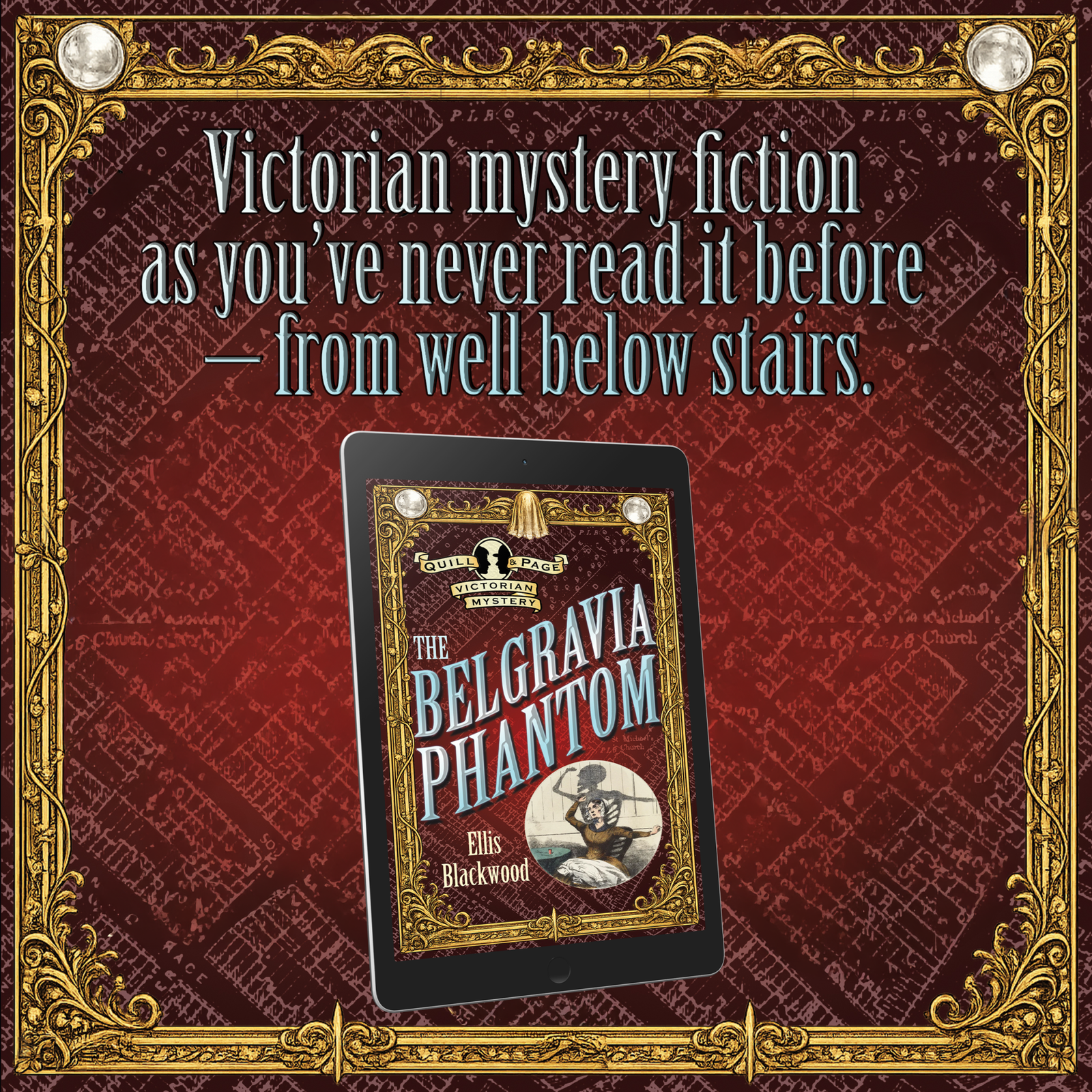
Victorian mystery fiction as you’ve never read it before
—from well below stairs.

The Belgravia Phantom

Series: The Quill & Page Victorian Mysteries, Book 1

Author: Ellis Blackwood

Genre: Historical Victorian Mystery

New Release on July 31!

༺ ABOUT THE BOOK ༻

How do you prove you didn’t scare Lady Pemberton to death with a phantom?


Such is Kate Quill’s quandary. The faked séance went horribly wrong, and now Inspector Hartwell of Scotland Yard has her in his sights.


Kate’s poor. Seamstress poor. But what she lacks in the pocket, she makes up for in allies.
There are her siblings. Daisy, the actress. Ned and Vi… There’s no way around this – they’re petty thieves.


There’s Mrs McGinty, their formidable Irish landlady. There are Vi’s Whitechapel Worthies, Little Till (adorable) and the Twins (quite odd).


And there is Frederick Page, former gentleman’s gentleman, chess aficionado, lover of puzzles, and now reluctant partner in an unlikely Victorian detective duo. Please, do not refer to him as Freddie, or he’ll be grasping for the smelling salts.


Can this glorious rabble somehow band together to investigate all those lofty lords and ladies who attended the séance?


And discover who really murdered Lady Dorothea Pemberton?


The Belgravia Phantom is the first in a series of irresistible Victorian murder mysteries from the acclaimed author of the Samuel Pepys Mysteries. Expect fiendish whodunits, singular characters and vivid history. Step into London’s gaslit and swirling pea-soupers, and hear those click-clack footsteps approach...

༺ WHY READ THIS BOOK ༻

Kate’s investigation begins from a position most Victorian detectives never occupy: she must solve the crime while poverty, class prejudice, and Scotland Yard’s suspicion work against her. The people assisting her are not respectable professionals with official access. They are siblings, lodgers, street children, thieves, and one exquisitely particular former servant whose knowledge of privileged households may prove as useful as Kate’s nerve.


That arrangement gives the mystery two distinct worlds to examine. Belgravia supplies the séance guests and their protected secrets, while Whitechapel supplies the improvised network capable of uncovering them. The contrast is not decorative background; it shapes who can ask questions, who goes unnoticed, and whose account is likely to be believed.


The excerpt also reveals an interest in the practical details of East End life, from costermongers and naphtha lamps to the small deceptions required to secure a hot meal. Readers can therefore expect the investigation to unfold alongside the routines, resourcefulness, and humor of characters accustomed to surviving without money or influence.

༺ read an EXCERPT ༻

Ned and Vi belong to the evening, when the naphtha lamps of the costermongers’ stalls hiss and flare, and all between is subsumed in shadow. When the streets still throng with shoppers, and the trams and cabs and omnibuses are lit by oil - white light, oncoming; red light, receding - and Whitechapel Road feels interesting to know. When the cries of the chestnut roasters, the fried-fish sellers and the pie-men create a cacophony of distraction. 


This is when they thrive. 


They have their stomachs set on the hawker of baked potatoes, with his lovingly polished can on four legs, its brass plaque proclaiming: “Old Original Baked Potatoes”. The old man who ran the stand for many a year lately died; his errant son has the business now, and shows rather less aptitude for vigilance. 


While Ned lurks in the background, Vi sidles up. Her head tilts this way and that, apparently undecided. She plays with an unseen coin in her hand. The bait. 


Glowing charcoal lights the lad’s face orange. He narrows eyes at her. Steam rises from his burner, and the earthy aroma of the treasure within. 


“What can I have for a ha’penny?” she asks. It is all she could spare, but it should suffice if she plays it right. 


He snorts. “On your way, missy. My prices start at a penny and no less.” 


She glances up and down the road, where the sellers either side, of ham sandwiches, hot green peas and eels, have patrons queueing. 


He kicks a heel. It has not been easy, taking over his father’s trade. The baker who roasts his hundredweights recently upped his fee, and the locals whose custom the old man relied upon have found new flavours elsewhere. Many deserted him for that other potato hawker in Spitalfields. 


As his gaze follows Vi’s, he licks his lips. “S’pose I might be able to find a small one.” 


He opens the wide half-lid, peers inside debating, and picks out the smallest spud he can find. 


“Butter and salt?” she asks innocently. 


“For a ha’penny? Don’t push yer luck.” 


As he hands over the plain fare, she fumbles the coin. The tiniest flick of her thumb sends it skittering into a gutter, his attention trapped on its progress. By the time he has retrieved it, mumbling sourly, Ned has pounced and vanished, melting into the crowd. He moves slickly for a big lad, even one cradling stolen potatoes in an untucked shirt. 


“Sorry. Butterfingers.” Vi smiles, savouring the spud’s warmth as she heads home.

༺ WHO WILL LOVE IT ༻

This opening case belongs on the reading lists of mystery lovers who prefer amateur investigators with limited means, sharp social observation, and allies drawn from beyond polite society. The partnership between Kate Quill and Frederick Page should appeal especially to those who enjoy contrasting sleuths: one practical and accustomed to improvisation, the other precise, puzzle-minded, and deeply conscious of proper forms of address. 


The East End ensemble offers another point of entry for readers who value found-family dynamics and supporting characters with active roles in an investigation. Those drawn to Victorian London will find both grand houses and crowded streets represented, while the séance, wrongful suspicion, and closed circle of aristocratic attendees provide the structure of a classic whodunit viewed from an uncommon social angle.

༺ ABOUT THE AUTHOR ༻

Ellis Blackwood writes very British historical mysteries: fiendish whodunits packed with singular characters, vivid period detail and plenty of wit. His completed nine-book Samuel Pepys Mysteries series is set in 17th century London. He is currently working on the Quill & Page Victorian Mysteries, featuring a found family of East End misfits investigating the crimes of the upper classes who cast them out. 


A former journalist, Ellis wrote features for the UK's most popular national newspapers and magazines before escaping to Cornwall with his wife, two daughters and Spike the dog. He holds an MA in Comedy Writing, which explains a lot. 


He grew up on The Hardy Boys and Three Investigators, graduated to Sherlock Holmes, and has never quite recovered from Columbo. He prefers writing female sleuths, with the odd chap thrown in, and is firmly convinced that historical settings are simply more fascinating. 


“Absolutely fabulous, reek of authenticity, full of intrigue and fun” – Amazon review of the Samuel Pepys Mysteries

༺ CONNECT WITH THE AUTHOR ༻

Website  •  Facebook  •  Instagram  •  Bluesky  •  TikTok  •  BookBub  •  Amazon  •  Goodreads

༺ BUY THE BOOK ༻

Amazon  •  BookBub

༺ enter the GIVEAWAY ༻

Follow the tour HERE for special content and a giveaway!

Enter The Belgravia Phantom Giveaway Here

༺ LAST WORD ༻

Kate Quill’s first case is built around more than the question of who killed Lady Pemberton. It also asks what an accused seamstress can learn when respectable society refuses to take her seriously—and what becomes possible when the people dismissed by that society combine their particular talents. The séance supplies the phantom, but the sharper tension lies in watching Kate and her unconventional circle challenge a version of events already accepted by those with authority. 


The Whitechapel excerpt makes the series’ intentions especially clear: the lives below stairs and beyond the grand squares are not incidental to the mystery. They are where the partnership, humor, and methods of detection take shape. For readers intrigued by a class-conscious Victorian puzzle with an ensemble of resourceful outsiders, The Belgravia Phantom offers a promising introduction to the Quill & Page investigations.

༺ JOIN THE CONVERSATION ༻

Be the first to see cover reveals, upcoming releases, exclusive excerpts, author features, and more. Join our growing community of readers and book lovers. 


➡️ Join Our Newsletter