Showing posts with label Writers. Show all posts

Tuesday, June 30, 2026

What Every Writer Should Know About Editing and Proofreading

You finally did it. After weeks, months, or maybe even years of writing, you've typed the words "The End." It's an exciting moment, and you deserve to celebrate it. But before your manuscript makes its way into readers' hands, there's one more important journey ahead: polishing your work.


Understanding the difference between editing and proofreading is one of the most important parts of preparing a manuscript for publication. Although the terms are often used interchangeably, they serve very different purposes. 


editing a manuscript

One of the most common questions new writers ask is, "Do I need editing or proofreading?" It's a fair question because the two terms are often used interchangeably. While both are essential parts of preparing a manuscript for publication, they do serve different purposes. If you know the difference, you can make smarter decisions about your writing, avoid unnecessary expenses, and produce a book that readers will enjoy from the first page to the last.


Whether you're self-publishing, submitting to a traditional publisher, or just wanting your manuscript to be the best it can be--understanding the editing process is a very valuable skill to learn.


What Is the Difference Between Editing and Proofreading?


The easiest way to think about editing and proofreading is to compare them to renovating a home.


Editing is the remodeling stage. You're improving the layout, fixing structural problems, replacing outdated features, and making everything work together more effectively.


Proofreading is the final walkthrough before the house goes on the market. You're checking for paint drips, crooked light switches, and small details that could leave a poor impression.


Both stages improve the final product, but they happen at different times and focus on different goals.


What Is Editing?


Editing is the process of improving your manuscript before it's ready for publication. An editor looks beyond grammar and spelling to evaluate how well your story or message works as a whole.


Depending on the type of editing you choose, an editor may help you strengthen your plot, improve character development, tighten pacing, eliminate inconsistencies, refine dialogue, and make your writing more engaging. They also look for repetitive wording, awkward sentences, and places where readers might become confused or lose interest.


Think of editing as a team collaboration. A good editor isn't trying to rewrite your story—they're helping your voice shine while making the reading experience smoother and more enjoyable.


Types of editing include:

• Developmental editing for writing structure.

• Line editing for tone and readability.

• Copy editing for grammar, punctuation, spelling, and factual errors or inconsistencies.


Each level of editing plays an important role, and not every manuscript requires every service. The key is understanding where your book is in the writing process.


What Is Proofreading?


Proofreading is the final review before publication. By this stage, your manuscript should already be edited, revised, and formatted.


Instead of making major changes, a proofreader looks for the small mistakes that inevitably slip through after multiple rounds of revisions.


A proofreader's job is to catch the small errors that are easy to overlook, including:

  • Typos and spelling mistakes
  • Missing words or awkward sentence omissions
  • Problems with punctuation, capitalization, or grammar
  • Inconsistent spacing between lines or characters
  • Formatting inconsistencies
  • Missing or incorrect page numbers


These details may seem minor to the overall novel, but they can really interrupt the reader's experience and even affect your credibility as an author.


Why Editing Should Always Come Before Proofreading


It's tempting to want everything cleaned up as quickly as possible, but proofreading too early often means doing the same work twice.


Imagine paying someone to correct every typo in Chapter Five, only to remove that chapter completely after an editor suggests a better structure for your story.


Editing is where the big changes happen to your book after your first draft. Chapters may be rewritten, scenes moved, character dialogue expanded or cropped, or entire sections removed. Once those editing revisions are complete, proofreading provides the final polish before publication.


Following the proper order saves both time and money.


Editing vs. Proofreading: A Quick Comparison


If you're still revising your story, developing characters, or restructuring chapters, editing is the service you need.


If your manuscript is complete and you're preparing to publish, proofreading is the final step to help ensure readers see your best work.


Editing improves the content.


Proofreading perfects the presentation.


Both are equally important.


Can You Edit Your Own Book?


Every writer should learn basic self-editing skills. In fact, the more polished your manuscript is before you hire an editor, the more value you'll receive from professional editing.


Before sending your manuscript to an editor, there are some things you can do:

  • Take a break from your manuscript for at least a week. Fresh eyes notice problems you've become blind to during the writing process. 
  • Read your work aloud. Hearing your sentences often reveals awkward dialogue, repeated words, and pacing issues that are easy to miss when reading silently. 
  • Change how you read your manuscript. Print it out or view it on an e-reader or tablet. A different format can help you notice mistakes that disappear on your computer screen.
  • Search for words you are overusing in your writing. Many authors rely too heavily on words like "just," "really," "very," "that," or "suddenly." Identifying these habits can make your writing stronger.
  • Embrace the value of using beta readers for early book feedback. Honest feedback from these trusted early readers can help identify confusing scenes that fail to flow well or inconsistencies in character behaviors before your professional editing begins. 


Helpful Editing Tools for Writers


Technology has become an excellent writing companion, although it shouldn't replace a human editor.


Several tools can help improve your manuscript before you invest in professional editing.


Grammarly offers suggestions on grammar, spelling, punctuation, and clarity that are especially useful during self-editing.


ProWritingAid provides detailed reports on readability, repeated words, pacing, dialogue, and writing style, making it a favorite among novelists.


Hemingway Editor highlights overly complex sentences and encourages clearer, more concise writing.


Microsoft Word Editor and Google Docs also include built-in grammar and spelling tools that can catch many common mistakes.


These programs are incredibly useful for polishing a draft, but they can't judge emotional impact, character development, storytelling, or whether your ending delivers a satisfying conclusion.


Common Myths About Editing and Proofreading


One of the biggest myths for writers is that a good spell checker is all you need. While modern software catches many simple errors, it won't recognize when you've used the wrong word in the right spelling or notice that a character's name spelling changed halfway through your novel.


Hiring an editor doesn't eliminate the need for final proofreading. Fresh proofreader eyes almost always catch a few missed, minor errors or flaws--even after the pros.


Some writers also believe that asking for editing is a sign of weakness. Nothing could be further from the truth. Every traditionally published book has been edited, often multiple times. Working with an editor isn't about fixing bad writing—it's about making good writing even better.


Choosing the Right Service for Your Manuscript


If you're unsure whether you are ready for editing or proofreading, ask yourself one simple question:

"Am I still changing the story?"


If the answer is yes, editing should come first.


If the story is finished, professionally edited, and you're preparing to publish, proofreading is the next logical step.


Knowing where you are in the process helps you invest your time and budget wisely.


Book Corner Takeaway


Writing a book is such an incredible achievement! But, creating a book that readers remember takes more than just finishing the first draft. It requires patience, revision, and a willingness to improve your work.


Remember, editing and proofreading aren't competing for the same role. The two are partners--collaborating in producing your professional manuscript. Editing strengthens your story structure and flow, while proofreading provides the final polish for the reader.


Whether you're publishing your first novel or your fifth, giving your manuscript the attention it deserves is one of the best investments you can make. Your readers may never notice great editing or flawless proofreading, and that's exactly the goal. They'll become immersed in your story, turning pages instead of spotting mistakes.


After all, that's what every writer hopes for.


Friday, January 9, 2026

NonFiction Book Review: The Compassionate Writer by Anne E. Beall, PhD

This morning, I have a nonfiction book for writers in our book review spotlight! Take a moment to learn about The Compassionate Writer by Anne E. Beall, read my thoughts on the book & enter for a chance to win a prize in the book tour giveaway at the end of this post.


Book Title:  The Compassionate Writer: Find Your Voice, Enhance Your Story, and Touch Lives by Anne E. Beall
Category:  Adult Non-Fiction (18+),  282 pages
Genrewriting craft and creativity
Publisher:  Beall Research
Release date:  October, 2025
Content Rating:  PG +M. Some mature themes like suicide, self-harm, sexual violence.​


Many of our posts contain affiliate links.

Should you purchase an item via our links--we may receive slight compensation from an
affiliate partner.  


About the Book
 
Write with courage. Edit with kindness. Share your story with the world.
Every writer struggles with self-doubt, fear of rejection, and the pressure to get it just right. But what if the secret to powerful writing isn’t striving for perfection—it’s embracing compassion?

In The Compassionate Writer, you’ll discover how to:
  • Silence your inner critic and trust your creative voice.
  • Write with vulnerability, emotional depth, and authenticity.
  • Craft complex characters and conflicts through empathy.
  • Overcome writer’s block and rejection with resilience.
  • Edit your work without losing confidence in your vision.
  • Build a supportive writing community that nurtures your growth.
Through psychological insights, practical exercises, guided visualizations, and writing prompts, this book will help you cultivate self-kindness, write with emotional honesty, and create stories that resonate deeply.

Your words matter. Your voice deserves to be heard. Whether you’re writing fiction, memoir, or personal essays, this book will guide you toward a writing practice that is both fulfilling and transformative.

Are you ready to write with compassion—and change the way you tell your story?
 
 
My Review
 

The Compassionate Writer is a Valuable Guide for Authors. This book takes a much-needed look at the importance of emotional, meaningful depth in written works — and offers writers tips and insights for incorporating the real world into both fictional and nonfictional work. With AI helping many "writers" create, this book is a vital resource and guide for writers seeking more emotionally resonant, well-validated content that inspires and engages readers. 


The Compassionate Writer is Easy to Read and Easy to Incorporate. The author's writing style is very organized and detailed, but also conversational and relatable. With personal stories, examples, tips and ideas inspired by experience, she offers readers a guide filled with valuable resources that feel accessible and easy to incorporate while writing.  


Would I Recommend The Compassionate Writer by Anne E. Beall, PhD? The Compassionate Writer is an excellent book for writers and creators who are just starting or at any stage seeking the confidence to share their own voice in print. The author provides step-by-step, logical guidance, prompts, and suggestions that are easy to follow and can be adopted immediately by writers. Expect is a great resource book for writers who want to offer more of themselves in their work. 


Buy the Book:
Amazon ~ Audible
B&N ~ Bookshop.org
add to Goodreads
 
 
Meet the Author


Anne E. Beall, Ph.D., is an award-winning author and social psychologist who writes about the emotional undercurrents that shape our lives. Her writing explores the psychology of relationships—between lovers, family members, friends, and pets who think they’re in charge.

She’s written eight nonfiction books, including Cinderella Didn’t Live Happily Ever After and Only Prince Charming Gets to Break the Rules, which reveal the hidden messages inside classic fairy tales. She has been featured in People Magazine, The Chicago Tribune, Toronto Sun, NPR, NBC, and WGN.

Anne is the founder and editor of Chicago Story Press Literary Journal, which publishes true stories that invite readers to see something in a new light. She holds a Ph.D. in social psychology from Yale—so yes, she can absolutely over analyze your childhood.

She lives in Chicago, where she writes, edits, walks a lot, and tries to convince other people that winter isn’t really that long in the Midwest.

connect with the author:  website ~ substack ~ linkedin youtube goodreads


Thursday, August 21, 2025

Nonfiction Spotlight: The Archaic Thesaurus by Nina Spinello

This morning, I have a nonfiction book in our book blitz spotlight! Learn about The Archaic Thesaurus by author Nina Spinello! 


Rediscover the Poetry of Forgotten Words


Nonfiction

Date Published: July 18, 2025

Publisher: ‎MindStir Media


Many of our posts contain affiliate links.

Should you purchase an item via our links--we may receive slight compensation from an
affiliate partner. 


About the Book

 
Step into a realm where language brims with history, elegance, and forgotten magic. The Archaic Thesaurus is a curated treasury of archaic and evocative words, crafted for lovers of language, writers, poets, and seekers of the uncommon. Author Nina Spinello revives the rich textures of English vocabulary with a masterful collection that both enlightens and inspires.
 

From “abstruse” to “zealous,” each entry is meticulously presented with: 


● The word’s pronunciation


● Part of speech


● Concise definition


● A vivid example sentence


● A list of thoughtfully selected synonyms—each with its own illustrative sentence


This A-to-Z compendium invites readers to embrace words like anathema, bellicose, laconic, and quixotic—expressions steeped in literary tradition and capable of transforming any piece of writing into something timeless. 


Whether you’re an author in search of the perfect word, a language enthusiast craving the eloquence of yesteryear, or a student eager to expand your vocabulary, The Archaic Thesaurus opens the door to a more expressive, poetic, and nuanced way of communicating. 


Perfect for:
✔ Writers and poets
✔ Lovers of classic literature
✔ Educators and students
✔ Word nerds and language explorers
 

Bring history into your vocabulary. Let these powerful words rekindle your imagination and elevate your expression. 


 Rediscover the art of language—one magnificent word at a time.


Buy the Book 

Amazon

B&N


RABT Book Tours & PR

Thursday, February 20, 2025

Podcast Review Spotlight: Book Marketing Tips & Author Success from Penny Sansevieri and Amy Cornell

Today, I have something a little different to share! I've had the opportunity to explore a business and marketing podcast geared toward author success! Check out the Book Marketing Tips & Author Success podcast, learn about the hosts Penny Sansevieri and Amy Cornell and read my thoughts on the podcast and the advice.


Many of our posts contain affiliate links.
Should you purchase an item via our links--we may receive slight compensation from an
affiliate partner.  
 

About the Podcast


The Book Marketing Tips & Author Success Podcast is a game-changer for authors who want to
thrive in today’s publishing landscape.


Penny Sansevieri and Amy Cornell blend practical advice with deep industry insights, offering
something for both new and experienced authors. Authors can expect honest guidance—no
gimmicks, no pipe dreams—just straightforward strategies you can actually use. And because
this industry can be tough, we keep it light with a bit of humor along the way. If you’re ready to
level up your author career, we’ve got you covered, no detail left unaddressed.


The reviews to date speak for themselves, with a lot of authors raving about what they’re
learning and encouraging others to get on board!


Sansevieri and Cornell believe in education, and creating a more savvy publishing industry – one episode at a time.


My Review


The Podcast Provides Helpful, Real-World Information. The hosts bring their own personal experiences to the forefront in this podcast as they make actionable, realistic, focused suggestions for authors seeking marketing tips (and success!)  I first listened to the episode "How to Get Your Author Website to Rank on Google" and took some notes from the ideas and suggestions--but I really enjoyed hearing the hosts' input and reality checks offered throughout. While the hosts certainly cover the SEO, "keywords are key," "images," "meta descriptions," etc., they really add context to apply these suggestions for authors to use in meaningful ways. 


Expect Focus, Organized Content. The podcast presents the information in a very guided, focused, and organized fashion. There are some side conversations, but even those are relevant and valuable to an author seeking book marketing direction. 


Would I Recommend Book Marketing Tips & Author Success from Penny Sansevieri and Amy Cornell? I learned a lot from this episode and found several key takeaways that I had heard before but that took on greater significance as the hosts connected the points to an author's success journey. The hosts connect well, and the dialogue is conversational and educational, without sounding preachy or forced. If you are looking for a real-world podcast geared toward helping authors understand the many hats of book marketing and author success, this is an engaging podcast that I look forward to listening to. 


The Hosts


Listen to the Podcast Today!

Tuesday, December 12, 2023

Self Help Book Review: Creating your First Novel by Hank Quense

Today, I have a wonderful self help book for new writers!  Check out Creating Your First Novel, read my thoughts on the book & enter the book tour giveaway at the end of this post!


Book Title:  Creating Your First Novel by Hank Quense
Category:  Adult Non-Fiction, 120 pages
Genre: Non-Fiction, Self Help, ​
Publisher:  Strange Worlds Publishing
Release date:  Oct 15, 2023
Content Rating:  G 

Many of our posts contain affiliate links.
Should you purchase an item via our links--we may receive slight compensation from an
affiliate partner. 


About the Book


Are you writing your first book? Or are you thinking about writing it?
Do you have any idea what you’re getting into?
No? Let’s talk about it.
Most aspiring authors concentrate on writing the book to the exclusion of all else. However, the reality is that creating a book is a long-term, multi-phase project and writing it is only one facet of the project.
The complete project involves five separate phases:
  • Planning the book
  • Writing the book
  • Publishing the book
  • Marketing the book
  • Author business issues
Unfortunately, planning and writing a book does nothing to prepare the author for the other phases of the project. The only commonality between the phases is that they are about a single book.
Another difficulty with the creative project is that almost all information on the process only discusses one phase of it.
Until now.
Creating Your First Novel covers all five phases.
It is written by an author who has gone through the project over two dozen times. Creating Your First Novel provides a road map to get you through the process without losing your sanity.
 
My Review

Creating Your First Novel by Hank Quense is Perfect for New Authors. Creating Your First Novel by Hank Quense is a comprehensive guide to creating a first novel loaded with encouragement and practical advice. The author breaks down the complex process of novel creation into manageable, bite-sized steps. This approach demystifies the writing process and makes it accessible to writers of all experience levels. From developing a compelling plot to crafting memorable characters, Quense provides a roadmap that is easy to follow and rich in insights.


Creating Your First Novel Blends Instruction Guide with Real-World Examples. The author's engaging writing style makes the learning experience enjoyable and accessible. Quense seamlessly blends instruction with real-world examples, drawing on his own experiences as a successful author to illustrate key concepts. This personal touch creates a connection between the reader and the material, fostering a sense of camaraderie and a shared passion for storytelling.


Would I recommend Creating Your First Novel by Hank Quense? Quense addresses common challenges and concerns budding authors face, offering practical solutions and words of encouragement. The book's upbeat tone is a constant reminder that the writing journey, though challenging, is ultimately rewarding. The author encourages readers to embrace their unique perspective and style. By doing so, he empowers writers to discover and hone their distinctive narrative voice, a crucial aspect of successful storytelling. Creating Your First Novel is a well-organized, well-presented self-help guide for new writers.


Buy the Book 
 
Meet the Author

Hank Quense has self-published his books for over 12 years. His non-fiction books cover fiction writing (Creating Stories), self-publishing (How to Self-publish and Market a Book, Self-publish a Book in 10 Steps), marketing (Book Marketing Fundamentals) and author business (Business Basics for Authors).

He also lectures on these subjects in schools, libraries and on webinars.

Hank recently started https://hankquense.podia.com/ The site provides solutions to pain points (problems) for fiction writers, self-publishing authors and authors who are trying to market their books.


Connect with the Author: Website X ~ Facebook Pinterest YouTube ~ BookBub ~ Goodreads
Enter the Giveway


Wednesday, October 11, 2023

Writer Self Help Book Review: Self-Publish a Book in 10 Steps by Hank Quense

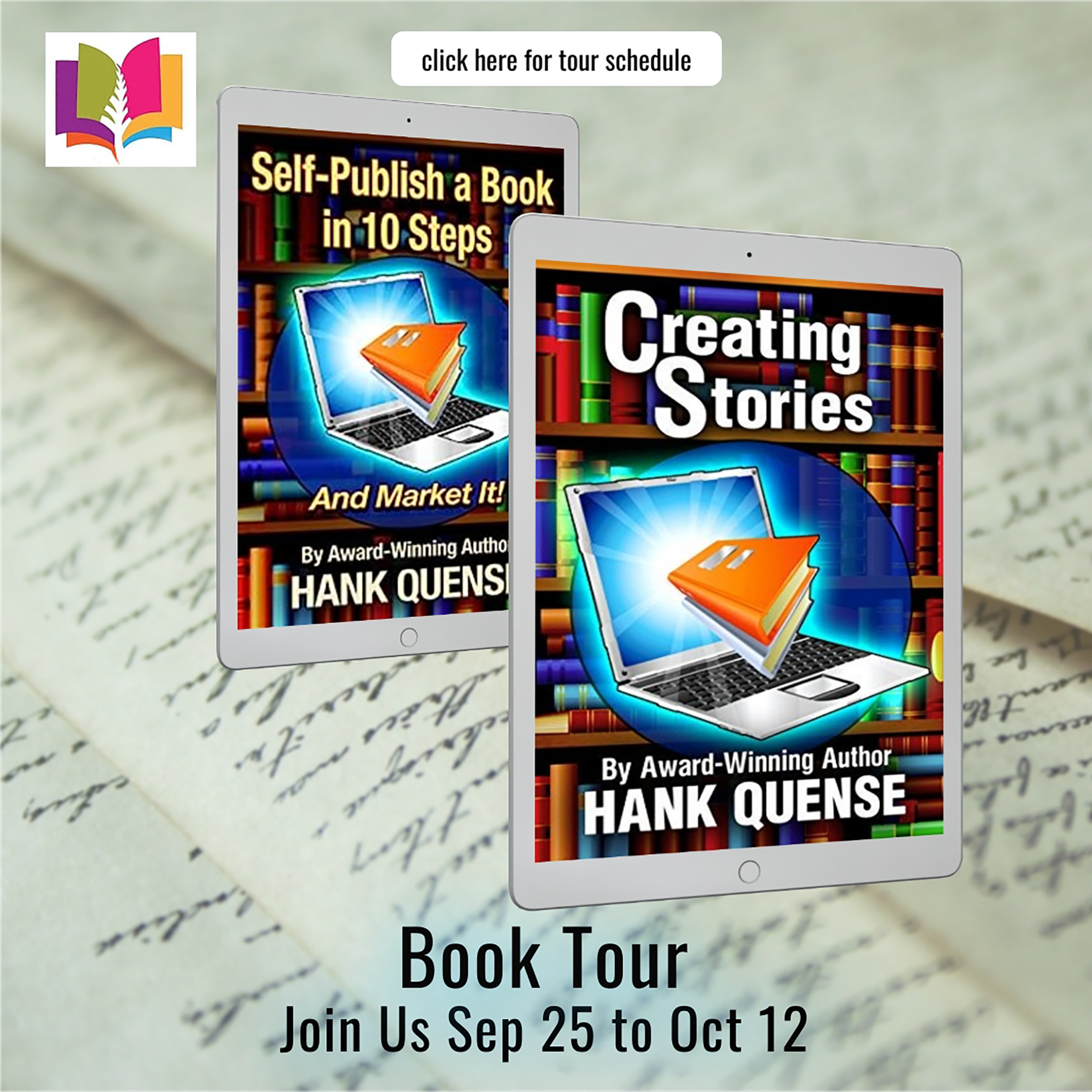
This week, I have a couple of self help books for authors in our book review spotlight. Today, I have Self-Publish a Book in 10 Steps by Hank Quense.  Check out this nonfiction guide for self-publishers, learn about the author, read my thoughts on the book & enter the book tour giveaway at the end of this post. If you missed yesterday's review of Creating Stories, you can check that review out here!


Book Title:  Self-Publish a Book in 10 Steps: And Market It by Hank Quense
Category:  Adult Non-Fiction, 88 pages
GenreSelf Help ​
Publisher:  Strange Worlds Publishing
Release date:  Dec 1, 2021
Content Rating:  G 


About the Book

Self-publishing a book is difficult.

This book simplifies it by breaking down a self-publishing and marketing project into 10 steps. This step-by-step process will get your book published and initiate the pre-launch marketing.

Hank Quense has written and self-published over twenty books, both fiction and non-fiction. He is the author of the Author Blueprint Series of books. The Series concentrates on providing valuable guidance on fiction writing, self-publishing and book marketing. Self-publish a Book in 10 Steps is Book 6 in the series.

The book details such vital tasks as developing a compelling book description, building an author platform and getting book reviews to list a few.

Learn the ten-step process that will self-publish and market your book!
 
 
My Review

Perfect Resource for New Self Publishing Authors. Oddly enough, the opportunity to review this book arrived at the ideal time. I have been working through the early stages of a self-publishing plan for a nonfiction book that I've been writing pieces and parts of for some time. This self-publishing guide from Hank Quense is the perfect, easy-to-understand blueprint of helpful information for writers new to self-publishing. I love the author's teaching style as he writes each step of his 10-step process! This book covers some of the obvious--like needing cover art and writing a book blurb--but also some things that I still needed to fully consider, like sizing the book dimensions, packaging, and obtaining an ISBN. 


The Author Gives Well Organized, Easy to Understand Guidance to Readers. Quense dives into the self-publishing world in a very organized, concise manner that quickly packs a lot of information. Readers will learn about each step of the self-publishing process, from formatting to marketing. The author provides enough details to give the reader a decent understanding of the requirements of each step. Then, he provides very well-placed tips and suggestions from his experiences and preferences concerning each stage. I read the book from cover to cover and thoroughly plan to revisit it, step by step, when it's time for me to begin my own self-publishing process. While it may not be an all-inclusive guide to self-publication, it is undoubtedly a valuable resource as I move through each step!


Would I Recommend Self-Publish a Book in 10 Steps by Hank Quense? Self-publishing is much more detailed than simply uploading a manuscript and waiting for readers to buy a copy! This book is both eye-opening to the steps involved and reassuring that self-publication is within the reader's ability! This book's writing style and structure are easy to read and understand and vital to new self-publishers learning the process. I recommend this book to new writers interested in self-publishing, especially those seeking to launch their first novel from manuscript to marketed work. This book is going on my e-book shelf to reference step by step as I work through my first self-published piece.


Buy the Book
 
 
Interested in Creating a Fictional Story?
 

Book Title:  Creating Stories by Hank Quense
Category:  Adult Non-Fiction, 106 pages
GenreSelf Help, ​
Publisher:  Strange Worlds Publishing
Release date:  April 1, 2017
Content Rating:  G 

Many of our posts contain affiliate links.
Should you purchase an item via our links--we may receive slight compensation from an
affiliate partner.  


About the Book


Do you have a story in you?

Do you know how to write it or how to tell it? Creating Stories has the answers. Hank Quense, the author of more than twenty books, tells you how to do it. He believes that stories come from the melding of three elements: getting ideas, story design and story-telling. Ideas have to come from the author. Creating Stories covers the last two. The book concentrates on developing characters including such rarely discussed requirements such as a dominant reader emotion and the character's biography. Plots are also covered in depth and a number of graphics are included to illustrate complex points. Another topic discusses subplots and how to utilize them and how to nest them within the main plot. A separate chapter discusses the relationship between the plot and the emotional arcs. Other topics covered are: character arcs, scene design, point-of-view, writing voice.
 

Buy the Book

Amazon
Add to Goodreads


Read a Guest Post from the Author

Creating a story

 by Hank Quense


Creating a story is a complex undertaking, no matter what type of story it is. One of the basic issues aspiring story creators have to face is where to start and how to go about putting the story elements together. After all, the writer has to deal with character, plots, scenes, setting and more elements. In the beginning, to many newbies, the task is almost overwhelming. And this issue applies to all types of stories: short stories, novels, memoirs, scripts, screenplays and more. No matter what type of story it is, it must deal with the same elements just mentioned.

The basic question many writers face is: Should I start with the character development? Or maybe the plot? Maybe I should get a setting first? This predicament can lead to mental paralysis.


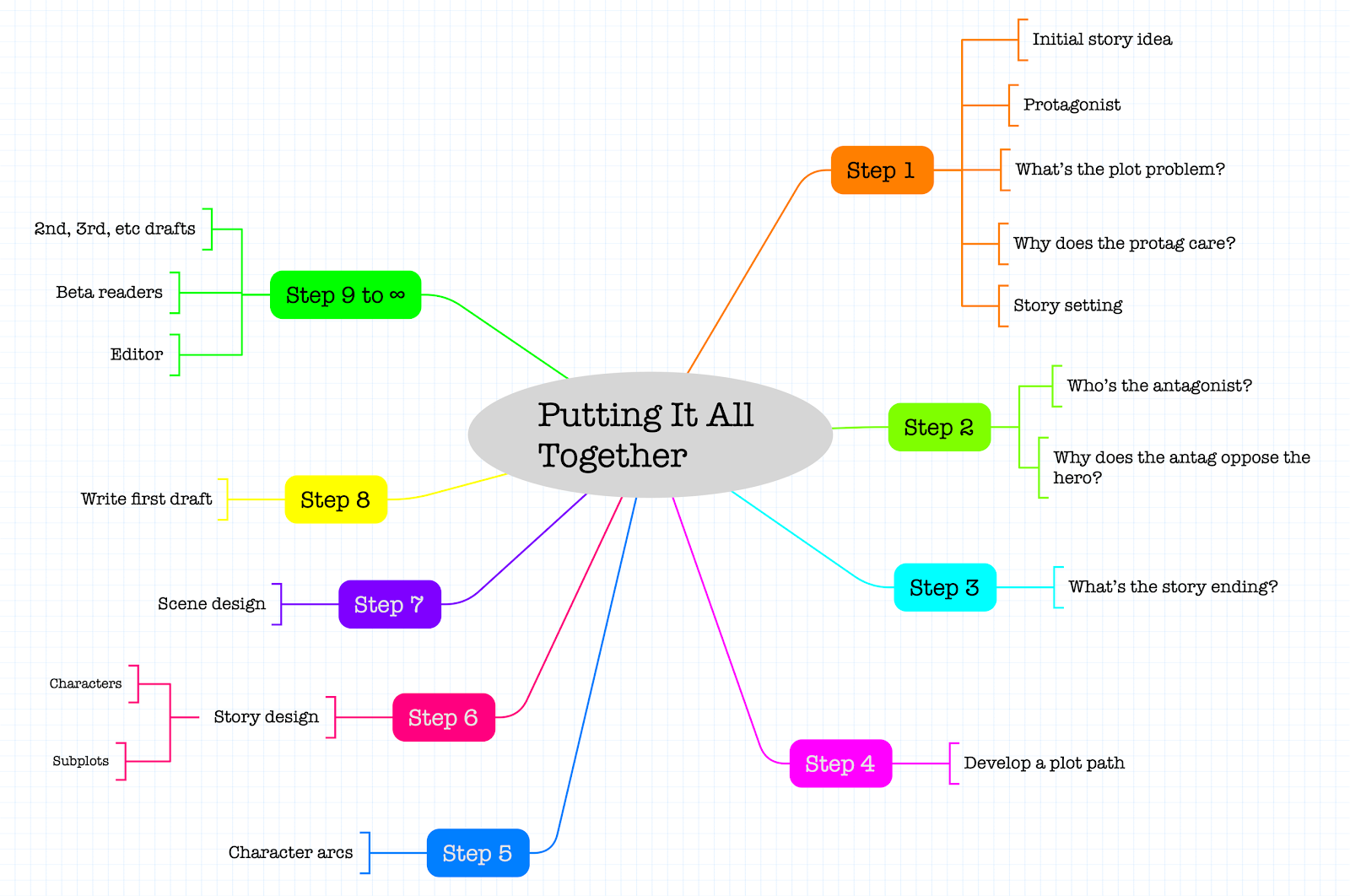
 PIAT.png


I’ve been writing stories since the last century and I’ve face up to to this issue and I’ve conquered it by developing a process I use whenever I’m creating a story. I call the process Putting It All Together and I wrote a book describing my process. In total, the process involves nine steps. These steps are depicted in the mind-map.


What may come as a shock is the fact that I don’t start writing the first draft until Step 9. Getting to that point can take quite a while and involves a lot of preliminary work. In the case of a novel or other type of long story, developing the initial steps in the process can actually take a few months.


The process is detailed at length in the book and it is free download on my site Writers & Authors Resource Center. You can grab your copy by following this link: https://hankquense.podia.com/putting-it-all-together


Meet the Author

Hank Quense has self-published his books for over 12 years. His non-fiction books cover fiction writing (Creating Stories), self-publishing (How to Self-publish and Market a Book, Self-publish a Book in 10 Steps), marketing (Book Marketing Fundamentals) and author business (Business Basics for Authors).

He also lectures on these subjects in schools, libraries and on webinars.

Hank recently started https://hankquense.podia.com/ The site provides solutions to pain points (problems) for fiction writers, self-publishing authors and authors who are trying to market their books.


Connect with the Author: Website X ~ Facebook Pinterest YouTube ~ BookBub ~ Goodreads


Enter the Giveaway

CREATING STORIES Book Tour Giveaway